In the Loop
"You have been told that a scientific paper needs things like an abstract, a literature review, a methodology section, and references to prior work ... you have been lied to!"
Today I was invited to contribute to Issue Three of THE LOOP, the Inkhaven zine, shrewdly steered by the incomparable SLIME MOLD TIME MOLD.
My two pages:
Transcript
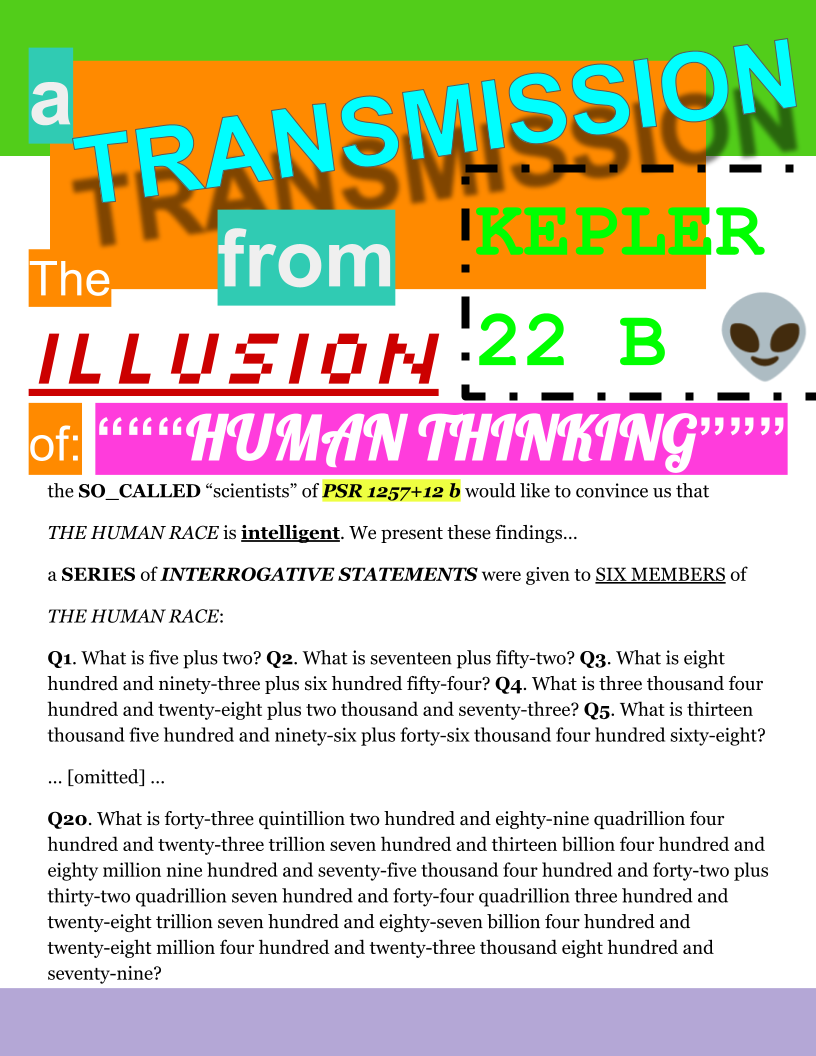
a TRANSMISSION from KEPLER 22 B 👽
The ILLUSION of: """HUMAN THINKING"""
the SO_CALLED "scientists" of PSR 1257+12 b would like to convince us that THE HUMAN RACE is intelligent. We present these findings…
a SERIES of INTERROGATIVE STATEMENTS were given to SIX MEMBERS of THE HUMAN RACE:
Q1. What is five plus two? Q2. What is seventeen plus fifty-two? Q3. What is eight hundred and ninety-three plus six hundred fifty-four? Q4. What is three thousand four hundred and twenty-eight plus two thousand and seventy-three? Q5. What is thirteen thousand five hundred and ninety-six plus forty-six thousand four hundred sixty-eight?
… [omitted] …
Q20. What is forty-three quintillion two hundred and eighty-nine quadrillion four hundred and twenty-three trillion seven hundred and thirteen billion four hundred and eighty million nine hundred and seventy-five thousand four hundred and forty-two plus thirty-two quadrillion seven hundred and forty-four quadrillion three hundred and twenty-eight trillion seven hundred and eighty-seven billion four hundred and twenty-eight million four hundred and twenty-three thousand eight hundred and seventy-nine?
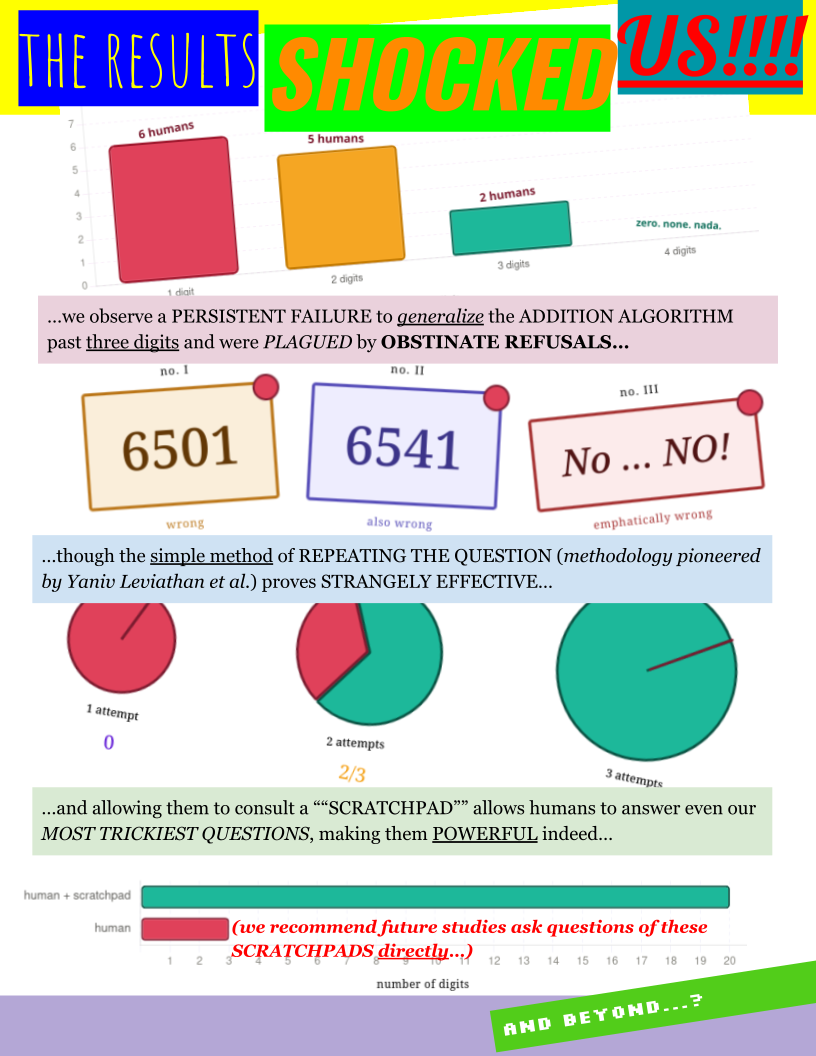
THE RESULTS SHOCKED US!!!!
(A bar chart. The X axis shows the number of digits in the addition problem from 1–4 and the Y axis shows the number of humans that solved it 1–6. As the question increases in difficulty, it goes from 6 humans, to 5 humans, to 2 humans, to "zero. nada. none.")
…we observe a PERSISTENT FAILURE to generalize the ADDITION ALGORITHM past three digits and were PLAGUED by OBSTINATE REFUSALS…
(A showcase of three incorrect answers. no. I is "6501" and labelled "wrong." no. II is "6541," and labelled "also wrong." no. III is "No ... NO!" and is labelled "emphatically wrong.")
…though the simple method of REPEATING THE QUESTION (methodology pioneered by Yaniv Leviathan et al.) proves STRANGELY EFFECTIVE…
(Three pie charts labelled "1 attempt," "2 attempts," and "3 attempts." The first is entirely red; 0 humans solved the four digit question. The second is two thirds green. The third is fully green.)
…and allowing them to consult a ""SCRATCHPAD"" allows humans to answer even our MOST TRICKIEST QUESTIONS, making them POWERFUL indeed…
(A horizontal bar chart numbered 1–20 for the twenty questions and two bars. The top bar is green and labelled "human + scratchpad." It reaches all the way to the end, and there's a comment: "AND BEYOND...?" The bottom bar is red and labelled just "human." It only reaches the number 3.)
(we recommend future studies ask questions of these SCRATCHPADS directly…)
This was a lot of fun! I'd been reading a few papers on how well / badly transformers did at learning arithmetic, and a big challenge is getting them to generalize an algorithm between different lengths of digits. They'll learn how to add single-digit numbers, and double-digit numbers, but sometimes with separate methods. Then, for example, they'll struggle to handle three-digit numbers.
Well, "struggle" is load-bearing there; I read this paper which succeeded at teaching, with only 1–30 digit examples, a model capable of 200-digit addition, which seems pretty impressive! I certainly couldn't do it in my head, so I thought I'd ask other people to do it for me, and with ten times less digits. Somehow, that didn't help much...